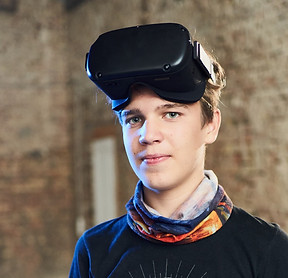
ARTEFACT: CHOrnobyl
On October 20, 2020, the ARTEFACT: CHOrnobyl project presented Ukraine at the XI Virtual Reality Festival in Spain (Madrid).
Prior to that, during a 3-month art residency, more than 100 digital artists, developers, curators and other professionals jointly created this project, which is the first virtual museum about the Chernobyl disaster using VR and AR, laser technologies, neural interfaces and parametric architecture.
Especially for this, the Chernobyl exclusion zone was virtually recreated, where all art projects were presented in separate VR spaces with their own mood and context, which can be immersed in from anywhere in the world, just from a computer browser or smartphone, but the maximum immersion can only be obtained in VR - helmets. They will also be able to be played and presented offline in physical space as soon as the opportunity arises.
The project was supported by the Ukrainian Cultural Foundation, the Ministry of Culture and Information Policy of Ukraine, the State Agency of Ukraine for the Management of the Exclusion Zone, the Ukrainian National Chernobyl Museum, the European Institute of Chernobyl, and the Pripyat Center, com.

Art residence
On the eve of the 35th anniversary of the terrible man-made disaster, it is time to rethink the information that was spread about the Chernobyl accident: manipulations, fakes and the consequences of the silence of the catastrophe by the Soviet authorities. And also to show a tribute of respect and reverence to those who died and suffered from this terrible accident.
For 3 months of the unique thematic residence, the creative duet of Timofey Voronkin and Victoria Lopukhina (studio ZViT) have done an incredibly rich and creative path: from the concept and sketch to the implementation of what was conceived in the code and the implementation of the finished exhibit on the platform of the ARTEFACT project: CHOrnobyl for display at international media art MADATAC festival on October 20, 2020.
The project "Narrative of Catastrophe" is not only an artistic and technical embodiment of the idea of an exposition for a virtual museum about the Chernobyl accident, but also a great work on collecting and processing information, which is an educational part of this exposition.

ARTIFACT: CHOrnobyl -
The first virtual exhibition about Chernoby
Narrative of Catastrophe
The word “narrative” means a story. In this case - it is a multiple narrative about an event that changed the fate of millions of people and divided the time into “before” and “after” the most terrible technogenic catastrophe of world significance.
Humanity received the first information about the disaster and its consequences from the pages of newspapers, because at that moment it was the most widespread and accessible media source.
Therefore, it was newspaper clippings that were the material for the exposition,
presented to the viewer in the form of a multi-layer collage that repeats the silhouette of the Chernobyl nuclear power plant.





Timeline
The entire virtual volume of this exposition looks like a half-cylinder, repeating the shape of the Shelter object, which was later built over the destroyed 4th power unit to protect the environment from the harmful consequences of the accident.
The base plane of the exposition is the visualization of the timeline of real events in chronological sequence - the timeline of the Chernobyl nuclear power plant. Events begin long before the accident, from the moment of choosing the location of the station on the banks of the beautiful Ukrainian Pripyat River until the events of today.
And even plans for the future of this enterprise, which is now directly related to the disposal of nuclear waste and the elimination of the consequences of that terrible accident that occurred 35 years ago.
Materials used from the site
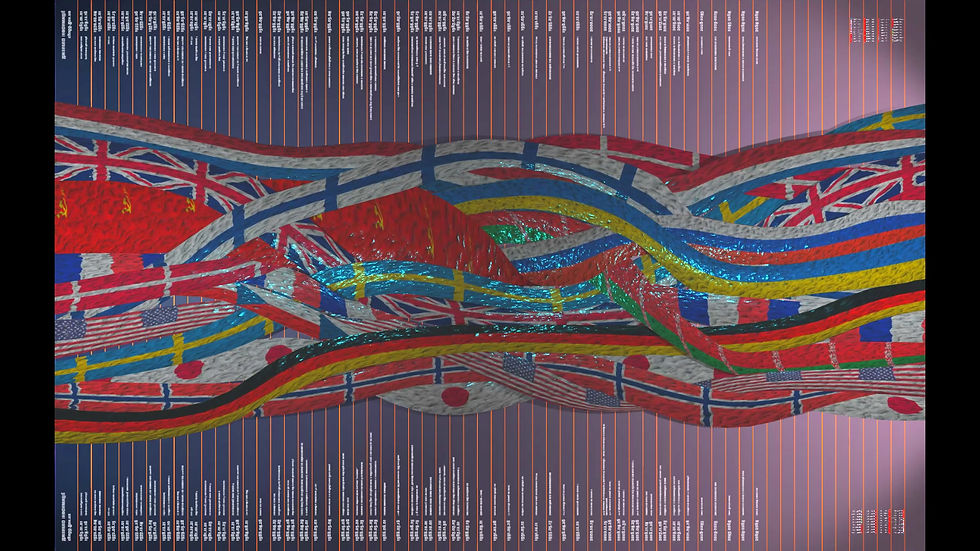
Information flow
All the information that fell on the readers of the media is depicted in the form of a river with streams of flags of the countries whose publications are used in the project. In the countries of the world and in the territories directly affected, the information in the columns of newspapers varies greatly in quantity and reliability, depending on the country, its leadership and political system.


.png)
.jpg)


.jpg)
.jpg)
.jpg)
15 countries - 50 publications - 350 articles
35 years old
One of the goals of the project "Narrative of Catastrophe" was, namely, to show the difference in information that was presented to the readers of the world media and the Soviet Union.
In order to create a code that lined the articles in chronological order, all found articles were placed in a table. And then it turned out that in terms of the date and time of publication, many countries, such as Sweden, Norway, Germany, France, the United States and many others, were ahead of that small note in the Soviet press, which informed the citizens of the USSR that a terrible tragedy had taken place in Chernobyl on the territory of Ukraine.
Here, this piece of code [19860501_Pravda_SSR], which is already 26 in chronological order!

35 countries - 220 NPP - 407 p.units
On the side of the exhibition, there is a wreath of flags depicting countries with operating reactors and the total number of nuclear power plants in the world, as of 2020.

Satellite images
On the opposite side of the half-cylinder, on which satellite images of the ChNPP territory from 1984 to 2020 are leafed. The candle that burns against their background is like a tribute to the memory and respect for the liquidators of the accident who died. It is the central composite axis of the exposure.

Narrative of Catastrophe
This image is a screenshot of the VR project of Tim Voronkin and Victoria Lopukhina (studio ZViT) "The Narrative of Catastrophe", this is a multi-layered collage from newspapers from different countries, which forms the outline of the Chernobyl nuclear power plant.
In the virtual space, articles from newspapers around the world are arranged in chronological sequence from the moment of the disaster to the present day and are consistent with real historical events at the ChNPP.
But to see all the layers, you need to virtually immerse yourself in the project and then you can read all these articles simultaneously and sequentially. And using the critical thinking and information from history that has become available to us over the years, you can fully form your own opinion about the tragedy, realizing the extent and consequences of the catastrophe.
A teaser of a project that shows an artistic idea.
(viewing takes one minute)
360 video
We also filmed a 360 video, in which, while watching a video, you can rotate the direction of your viewing with a computer mouse and see everything around, similar to what happens during a virtual reality tour. This technology allows you to show as best as possible the effect and impression that the project produces in virtual reality.
The authors of the project really hope that someday the viewers will have the opportunity to watch this project, wearing a VR helmet and plunge into the virtual space of the art project "Narrative of Catastrophe".
Here you can fly up to each of the 350 articles and read them all at once. No library can do this so quickly and at the same time. You would spend an incredible amount of time to get this information.
Also, unlike all other real museums, you can go and dive under the exhibits and sweep over the stream of flags - visualization of media information from around the world.
And so, we return to the final point of our excursion - the sign of radiation, which can do so much harm if used improperly.
With the mouse, change the direction of view

"Narrative of Catastrophe"
VR project